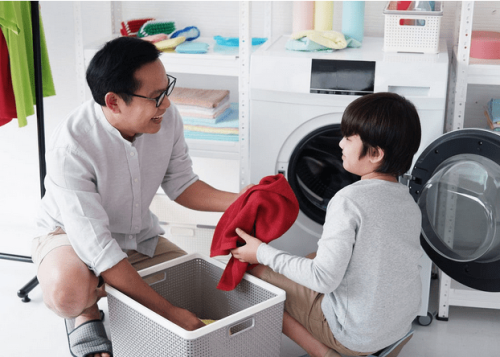
How to develop shared goals in your family
Julie Bogart, Brave Learning
May 19
In all our fretting over how to raise kind, respectful children, the temptation is to double down on discipline—to require “instant obedience.” And indeed, if all those little rascals would just do what I ask when I ask it I would feel waves of joy—explosions of glee, wouldn’t you?
Most obedience systems rely on some kind of punishment to enforce them—be it, time outs or spanking or withholding of privileges (or even withholding smiles—I read that once!). Yet the most effective way to ensure a child behaves in a manner acceptable to you is to help that child cultivate the skill that you want to see bloom! The dynamic relationship between parent and child is what leads to greater and greater ease between them.
Today, we call this interaction “collaboration.”
Collaboration is the value that says: “Together, we will secure a healthy, respectful relationship while developing habits that help us meet our goals.”
Those goals are shared, not imposed.
Obedience is too often a synonym for “coercion” rather than “glad cooperation.”
Collaboration, as a value, allows us to take into account the child as person, and our unique vantage point as parents. We can first get to know what the child needs, address that need, and then work to create the conditions of partnership to achieve our goals.
It might look something like this:
On occasion, when I had kids at home, I would need to go to Target. Often, my kids would be playing video games when it was time to leave. I recognized that this was a challenging transition for my kids. So I talked to them about how sometimes I might need to interrupt their play in order to meet an objective or need I had that they didn’t share. I asked them how we could make the transition smooth, and we decided together that a five minute warning would help.
So we practiced…
We practiced the transition (no Target shopping trip about to occur). I gave a fake five minute warning and we found out if it was possible to wind up video games in five minutes. Kids gave their input. “Yep, that was plenty” or “No, I need 15 minutes of warning.” More practice.
In the end, we settled on 7-10 minutes of warning time. It helped them to know that I was working with their needs that were in conflict with mine, rather than imposing my will in what felt arbitrary to them.
Try it! Practice disengaging in time to leave the house for an outing.
When the real Target-trip-moment comes, instead of expecting your kids to hop up and put away their games the moment you feel ready to leave, follow your solution:
“In fifteen minutes, we’ll need to head to the car to go to X location. Now is a good time to get to a stopping place on your game.”
Usually when you’ve taken the time to be respectful of your children’s needs, they’re more willing to respect yours. It’s a dialogue. It’s not solved once and for all, and it doesn’t mean you’ll get perfect cooperation every time. What collaboration provides is a two-way street—everyone aware that their behaviors impact others both adversely and positively. Negotiating how to sustain the positive is the goal.
Respect for personhood is essential.
Just because the situation seems easy for me to solve with one idea doesn’t mean that idea works for everyone. Collaboration requires a tolerance for views that interfere with our own best ideas about the subject.
Collaboration builds trust and cooperation that facilitates learning.
Collaboration brings peace. In fact, in trusting respectful relationships, kids do sometimes simply hop right up when you call them and that experience really IS pleasing to the parent.
For more support, listen to this Brave Writer podcast episode: https://juliebogart.substack.com/p/obedience-vs-collaboration