Peel your family away from their screens this holiday season with games for every type of person – vetted by our panel of specialists
Monday, December 22
There is nothing wrong with getting together as a family to watch a movie or play some video games. But gathering around a table to play a board game can peel kids off their screens and pull families together in a way few things can. That’s a big reason why family game night is such a treasured tradition in many households, especially during the holidays.
You could opt for classics such as Monopoly and Scrabble of course, but there is so much variety and diversity in modern board games that you would be missing out. If you’re willing to expand your horizons, we promise there’s a new game on this list that will have your family members clearing calendars for a rematch.
At a glance
Best overall game: Bomb Busters
Best cooperative game: The Gang
Best budget game: Flip 7
Best game for large groups: Hues and Cues
Best for young kids: Ticket to Ride: First Journey
Why you should trust me
I have played modern board games for nearly two decades, with three large shelves in my living room overflowing with games. I’m always down for a game of King of Tokyo, but I’ve also lost hours to Wingspan and my personal all-time favorite, Sleeping Gods. I constantly refer to the BoardGameGeek forums, visiting Gen Con is on my bucket list, and I sometimes facilitate Ladies Game Night over at my local game store.
To assemble this list, I chatted with several board game retailers and experts with a special focus on family-oriented games. Based on my own knowledge of the industry and experience playing many of the titles they mentioned, I trust their expertise.
I gave each expert category ideas like cooperative games, games for big groups, and games for young kids, then compiled their recommendations for each. The top pick in each category goes to the game that was most frequently recommended by our experts, but my conversations turned up all sorts of fun alternatives, which are also provided.
The experts
Taylor Chavez from Gamescape San Francisco, a board game store established in 1985.
Peter Ballou from Dogpatch Games, a tabletop and board game community hub in San Francisco. Dogpatch Games frequently runs gaming events for kids and families.
Ambie Valdes, a board game content creator who is a co-host on Board Game Blitz, a bi-weekly podcast and video series. She also creates board game song parodies and is a mother of two children.
Mik and Starla Fitch from Our Family Plays Games, a family-run business (which they run alongside their son Grant) on a mission to grow awareness of the modern board game hobby while championing diversity, inclusion and equity.
Suzanne Sheldon and Mandi Hutchinson from Salt & Sass Games, a board game podcast and streaming channel. Sheldon is a mother of two children and Hutchinson is a teacher in Ontario, Canada.
What makes a good family board game?
Most of the experts agree that the primary characteristic of a family board game is that there should be a low barrier to entry. “We love to give suggestions of games that are easy to learn,” said Starla Fitch. “Most people are not going to sit around and read a rule book for an hour. We try to find things you can learn within 10 to 15 minutes.”
Chavez knows time is tight and attention spans are short. “We’re not going to send you on something that takes 45 minutes to just learn,” he says. “Ideally it’s something you can pop out, learn in a few minutes, and then just run with it.” The game length shouldn’t be too long either. “Around 30 to 45 minutes is the sweet spot,” said Hutchinson.
Other considerations include a wide age range and a large player count, in case you have an intergenerational family or there are guests over for the holidays. “When we’re thinking of family board games, we think of flexibility,” said Ballou. He also likes games that come in relatively small package, so they’re easily portable.
Best overall game: Bomb Busters
- Two to five players
- 30 minutes of play time
- Ages: 10+
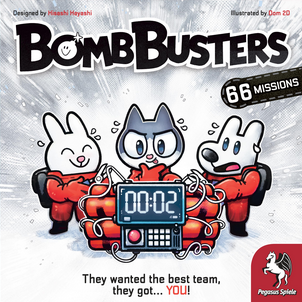
One game kept getting recommended by our experts more than any other, and that was Bomb Busters. It also happens to be the winner of the 2025 Spiel des Jahres, the world’s most prestigious award for board and card games. “It’s a cooperative game with deduction and limited communication,” said Valdes. “Those are all things I love.”
In Bomb Busters, everyone is working together to defuse a bomb by cutting the right wires. The wires are represented by tiles numbered 1 through 12 which are then dealt out amongst the players. There are 66 missions and each plays a little differently, but the goal is always the same: go through all 12 numbers without the bomb going off. Players take turns pointing at each other’s wires, guessing their values, giving hints and cutting wires if the guess is correct.
“The difficulty goes up each time you go through the missions,” said Mik Fitch, who picked Bomb Busters as the best cooperative game. “You’re going against villains, trying to save the world from people that want to blow it up. It’s a lot of fun.”
Other picks for best overall game
For a soothing puzzle: Cascadia
- One to four players
- 30-45 minutes of play time
- Ages: 10+
Cascadia is another widely praised pick, especially for those who want a lightly competitive yet gentle nature-based game. It was also the Spiel des Jahres winner in 2022. Set in the Pacific north-west, the object of Cascadia is to build out habitats by laying terrain tiles and then populating them with the appropriate wildlife. You gain points based on matching terrain and if you satisfy various wildlife goals – like creating a run of salmon or keeping hawks away from other hawks. “It’s just a beautiful game,” said Starla. “I think it can resonate with a lot of people, especially if you like the outdoors.”
For strategy that evolves: Harmonies
- One to four players
- 30-45 minutes of play time
- Ages: 10+
If you can’t find Cascadia in stores, Harmonies is a great alternative. It’s a newer game (published in 2024) so it tends to be more available. Like Cascadia, Harmonies is also about building an ecosystem with habitats and wildlife, but it is slightly more strategic. It’s also one of Sheldon’s and Hutchinson’s picks for best overall game. “The art is adorable,” said Hutchinson. “The rules are very straightforward, very clear, but there’s still a lot of gameplay. It’s different every time you play it.”
For a cozy afternoon: Creature Comforts
- One to five players
- 45 minutes of play time
- Ages: 8+
Another favorite is Creature Comforts, where you play cute woodland creatures gathering goods to fix up their dens for the winter. The Fitches describe this as a very cozy game, perfect for the winter. “It’s cute, but there’s a bit of strategy involved,” said Mik.
For dominoes with a twist – Kingdomino
- Two to four players
- 15-25 minutes of play time
- Ages: 8+
Kingdomino is an excellent game to introduce to your family, especially if they’re already familiar with dominoes. In Kingdomino, you’re exploring new lands to expand your kingdom. It uses terrain tiles with two sections, very similar to dominoes, which you then match for points. “It’s really simple,” said Hutchinson. “Even young kids can understand matching water to water.”
For a rowdy, fun time (and large groups): Hot Streak
- Two to nine players
- 20 minutes of play time
- Ages: 6+
If you want to have a raucous family game night, Hot Streak is where it’s at. In Hot Streak, you race mascots along a race track (Think the Milwaukee Brewers’ sausage race, but sillier). Players bet on which mascots they think will win, and then flip cards to move the mascots along the track. Sometimes they’ll move forward; sometimes they’ll swerve to another lane; sometimes get turned around and run backwards.
“The mascot race is hilarious,” said Sheldon. “There’s so much fun, delightful stuff in this game. It’s great for a crowd and anybody can play it, even young kids. There’s a bit of spectacle about it so everybody can be engaged and enjoy it, no matter how much they’re playing.”
“It’s so funny,” Hutchinson agreed. “The figures also look amazing, the racetrack is a roll-out mat as well. It’s very well-made.”
Best cooperative game: The Gang
- Three to six players
- 20 minutes of play time
- Ages: 10+
The Gang is essentially a cooperative version of Texas hold ’em poker. “It’s easy to play and people we played with just love it,” said Mik Fitch. “There are cards that teach you the hierarchy of poker hands so you don’t have to know poker to play.”
In The Gang, players bet on how good they think their hand of cards will be in order of first to last. As more cards are revealed, their hands are reevaluated through communication, but without explicitly revealing their hand. For example, you can say: “I have a really good hand, I think I could win this” and then vote accordingly. If all players correctly assess their hands, they get to open a bank vault. If not, an alarm is tripped. Open a bank vault three times, and everyone wins.
Other picks for cooperative games
For complete beginners: Forbidden Desert
- Two to five players
- 45 minutes of play time
- Ages: 10+
For people who are completely new to cooperative games, Chavez thinks Forbidden Desert is a good introduction. In it, you’re stranded on a desert and you and the other players have to work together to recover a flying machine and escape the desert’s treacherous shifting sands. A slightly easier version of Forbidden Desert is Forbidden Island, which also comes highly recommended as a great cooperative game.
For a popular classic (or stocking stuffer): Hanabi
- Two to five players
- 25 minutes of play time
- Ages: 8+
Another popular pick for a cooperative game is Hanabi – also a good stocking stuffer. Players must work together to place cards in the right order in order to put on a fireworks show. That seems simple, but there’s a twist: you can’t see your own cards because you hold them facing other people. You have to try to give hints about what their cards are with clue actions and tokens, and no other communication.
For a mindmeld vibe: The Mind
- Two to four players
- 15 minutes of play time
- Ages: 8+
In The Mind, you’re trying to play cards from one to 100 in a single stack – but without any communication. “Basically, you’re trying to create a hive mind,” says Chavez, who recommended it as one of her favorite cooperative games. “You just have to go off vibes and people looking at you intently.” Like with Hanabi, this would make for an ideal stocking stuffer.
For a game you can jump in and out of: The Game
- One to five players
- 20 minutes of play time
- Ages: 8+
The Game is very similar to The Mind – except it’s slightly easier to win. Instead of playing the cards sequentially in real time, you play in clockwise turn order. The cards are also placed on four stacks instead of just one. Limited communication is allowed, like pointing at cards and giving hints. Hutchinson especially likes The Game because you can jump in and out. “If a kid or somebody gets bored while they’re playing, they can just hand their cards to someone else and the play can continue,” she said.
Best budget game: Flip 7
- Three to 18 players
- 20 minutes of play time
- Ages: 8+
Flip 7 was frequently mentioned as an excellent game for multiple categories, but at just under $8, it’s also a perfect budget pick. It can also accommodate large groups since it plays up to 18 people, and works as a stocking stuffer due to its small package. You get a whole lot of bang for very little buck.
The goal of Flip 7 is to get 200 points. There’s just one instruction: flip over cards without flipping the same number twice. That might sound easy, but there are several special cards that could help or hurt you in your endeavor. “It’s like Uno meets blackjack,” said Chavez, describing it as a push-your-luck game. “You keep going: ‘Can you risk it? Can you risk it all?’” said Mik Fitch. “It’s a lot of fun.”
Other picks for budget games
For those who want a fun word to shout: Cabanga!
- Three to six players
- 20 minutes of play time
- Ages: 8+
Cabanga is a small, lightweight and inexpensive game (making it good for a stocking stuffer) that costs just $10. In it, you attempt to shed cards from your hand by matching them to the row in the middle. If there’s a large number gap between the two cards, other players can shout “Cabanga!” and toss in cards with values in between the two, forcing you to pull from the penalty pile.
For testing your reaction time: Taco Cat Goat Cheese Pizza
- 2-8 players
- 10-15 minutes
- Age: 8+
Valdes picked Taco Cat Goat Cheese Pizza ($10) in part because it’s simple and quick, which is great for people who aren’t usually into playing games. “It’s a speed card game with those cards [taco, cat, goat, etc] and you alternate flipping them over while saying the names in order,” she said. When the card sequence matches the name of the game, everyone slaps their hand on the pile and the last player has to pick up all the cards. The first person to get rid of all their cards wins.
Best game for large groups: Hues and Cues
- 3-10 players
- 30 minutes
- Age: 8+
When it comes to party games, Hues and Cues is often mentioned as a crowd favorite. It’s also pretty simple to teach. Players must describe a color using only one or two-word clues, while others try to identify it on a grid of 480 hues. The closer your guess to the answer, the more points you get. “I had someone we were playing with who pulled a purple and said ‘Grimace,’” said Chavez. “And we were like, ‘Oh no, what does Grimace even look like?’”
Other picks for large groups
For large parties who want a quick game: Green Team Wins
- Three to 12 players
- 15 minutes of play time
- Ages: 10+
In Green Team Wins, players compete to come up with the most popular answer based on a series of questions. Example questions are: “What color should green be? Lime, apple or watermelon” or “curly fries or waffle fries?”. If you give the most popular answer, you join the green team, if you don’t, you join the orange team. Players can often switch teams based on their answers. After 15 rounds, if you’re still on the green team, you win.
Best for young kids: Ticket to Ride: First Journey
- Two to four players
- 15-30 minutes of play time
- Ages: 6+
Ticket to Ride is a popular game where players compete with each other to build train routes across the map on the board, and First Journey is the junior version. “It has less cards to deal with, the train pieces are chunkier and the routes are shorter,” said Starla. “The rules are also a little different so younger kids will have a better gaming experience. It’s not as competitive as the big Ticket to Ride.”
Other picks for young kids
For fans of silly animals: Dodos Riding Dinos: First Race
- 2-6 players
- 15-20 minutes
- Age: 7+
For a more exciting alternative, the Fitches recommend Dodos Riding Dinos: First Race. “It’s cute because you’re racing these little dodo birds riding dinosaurs,” said Starla. Not only do players race their Dodos and Dinos, they can also launch projectiles at their opponents. There’s also a more grown-up version of this game just called Dodos Riding Dinos, but the Fitches say that version is more competitive. “The adult version can be pretty mean,” said Mik. “That could maybe hurt some feelings. The kid version is friendlier and the race is shorter too.”
For kids who like spooky themes: Zombie Kidz Evolution
- Two to four players
- 15 minutes of play time
- Ages: 7+
In Zombie Kidz Evolution, players are young students at a school working together to stave off a zombie invasion. This is a “legacy” game, which means the game changes over time. That in and of itself could prove exciting to young children. “It’s a very simple game,” said Valdes. “But after you play a few times, you unlock new rules and abilities, so it’s an evolving game. You get to put stickers in the rulebook and open up envelopes, and my kids love that.”
For kids who like playing with bugs: Kabuto Sumo
- Two to four players
- 15 minutes of play time
- Ages: 6+
Kids can live out their insect dreams in Kabuto Sumo, where players take on the role of beetles trying to win a wrestling match against other beetles. “You want to push the other sumo bugs off the tree stump” said Chavez. “It’s very tactile and cute.”
For aspiring junior detectives: Outfoxed!
- Two to four players
- 20 minutes of play time
- Ages: 5+
If your kids like solving puzzles, then consider Outfoxed!, a deduction game where players have to work together to find the fox who stole a pie. “I’ve played this a ton with my kids, and we love it every time,” said Sheldon. “You’re all tromping around this board and there are cute little clues that you uncover while working together. Even as an adult, I was fully engaged!”
Honorable mentions
For more mature players: Monikers
A couple of our experts suggested Monikers, a trivia and charades-style party game, as well as Ransom Notes, a magnetic poetry game, as good family games. They skew a little older (17+) so we didn’t include them here, but we thought they’re worth noting in case your family also skews a little older.
For more patient players: Unlock!
The Unlock! series of escape-room style games were also recommended a couple of times as good cooperative options. Some of these easily last close to an hour in play length, however. They can also only be played once – as is typical of escape room games – so that is something else to consider. That said, these are very popular and there are over 20 different variations of them so they’re worth checking out.
Source: https://www.theguardian.com/thefilter-us/2025/dec/22/best-family-board-games
There were also a lot of game recommendations we didn’t include because there just isn’t enough space for all of them! Here are the options that didn’t quite make it in: